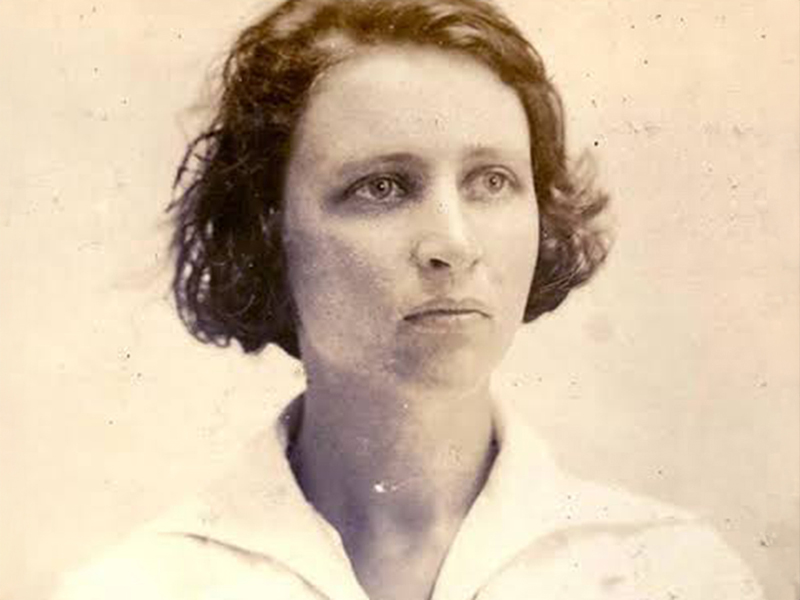
The ‘Practical Unreason’ of a Hard-Headed Logician
Research Period: 01.05.-31.08.2026
Field of Research: Epistemology, History of Philosophy, Vienna Circle, Women in Philosophy
Activities: Online Research of Schlick-Zirkel Protocols (Rose Rand Papers, University of Pittsburgh), Virtual Archive of Logical Empiricism VALEP (Carnap Papers); Estate of Eugen T. Gadol and Arthur Pap, Institute Vienna Circle, University of Vienna
ABSTRACT
The young logician Susanne K. Langer (1895-1985) matched, if not catalysed, the philosophical rigour of her contemporaries of the analytic branch in Vienna. Her first book, The Practice of Philosophy (Henry Holt, 1930) demonstrably inspired Professor Moritz Schlick to refer to her publicly in his lecture “The Future of Philosophy” held at the Philosophy Club of the College of the Pacific in December 1931,[1] and draft a manuscript of his own, titled “Philosophy as the Pursuit of Meaning,” which he drew upon, quoting passages from Langer’s book. He praised her coining of the ‘analytic type’[2] of philosophy that, for him, exemplified “the true kind” whose method “will be the only method of future philosophizing.”[3] The same year, Schlick ordered offprints for his students, and W.V.O. Quine mentioned in a 1933 letter to Henry Sheffer that the book had been “summarized and discussed”[4] at Schlick-Zirkel meetings in Vienna just before he left. In his letter to the publisher Henry Holt, Schlick wrote with unambiguous enthusiasm about her book, but remarked that its second part, particularly her chapter on “Insight,” fell into “a more traditional attitude.”[5] It is this very chapter in which Langer opens with her remark to the “hard-headed logicians” that her title “will probably suggest a decline of the author’s Pure Reason, and the advent of some Practical Unreason” regarding what she terms ‘unlogicized’ symbolisms beyond formal propositions. Langer thematises this domain of meaningful and structured human understanding again in 1939 at the Fifth Congress for the Unity of Science at Harvard. Since then, it seems, her work disappeared from the consciousness of Vienna Circle members.
This research proposal seeks to further illuminate Langer’s critical involvement in and discussion of her expansion of formalism to the proto-linguistic matrices of ritual, myth, and art. Moreover, to regard her in continuation of the Vienna Circle’s legacy – not as an external critic, but as a rigorous developer of the symbolistic paradigm that logical empiricism had itself inaugurated. It positions her alongside other women Philosophers of the movement: Analytic philosopher L. Susan Stebbing, stenographer and philosopher of the Schlick-Zirkel Rose Rand, Olga Hahn-Neurath (Boolean algebra) and mathematician Olga Taussky-Todd (matrix-theory).
[1] Moritz Schlick, “The Future of Philosophy”, College of the Pacific Publications in Philosophy, no. 1 (1932): 45–62.
[2] Susanne K. Langer, The Practice of Philosophy, 17.
[3] Moritz Schlick to Henry Holt. 22. March 1931. Moritz Schlick Papers [1882–1936] (103/Holt-1). Haarlem: Vienna Circle Archive. In: Sander Verhaegh, “Susanne K. Langer and the Harvard School of Analysis”, The Bloomsbury Handbook of Susanne K. Langer, 27.
[4] Willard Van Orman Quine to Henry Sheffer, June 16, 1933. W.V.Quine Papers [1908-2000] (MS Am 2587). Houghton Library, Harvard University (retrieved by Sander Verhaegh).
[5] Moritz Schlick to Henry Holt, 22. March 1931. Moritz Schlick Papers, 1882–1936 (103/Holt-1). Haarlem, Vienna Circle Archive (retrieved by Verhaegh).